Easy Mango Puree For Babies | 6 months +

Mango Puree For Babies

Mango is a sweet and nutritious first food option for babies. Its flavor is sweet and mild and texture easy to manage for infants. In this post you will get the recipe for an easy mango puree for babies 6 months and older.

MANGO PUREE FOR BABIES | 6 MONTHS +

Mango Puree For Babies

Easy Mango Puree For Babies | 6 Months +

Quick and easy mango puree for babies that are also freezer friendly. Get recipe here.
Prep Time 5 minutes
Total Time 5 minutes
Course Main Course
Cuisine American
Servings 2

Ingredients
  

  • 1 ripe mango
  • splash milk/breastmilk/formula milk

Instructions
 

  • Choose a ripe mango and cut into pieces.
  •  In a blender blend the mango pieces with a splash of milk/breastmilk/formula milk to get a puree like consistency.
  • Serve as is or along with a side of yogurt to add more protein and healthy fat to the meal. 

Notes

If you don’t have access to fresh mangoes, you can also use frozen mango cubes.
For babies under 1 use breastmilk or formula milk.
Keyword baby food, baby recipes, mango puree for 6 month old, mango puree for 7 month old, mango puree for babies, mango puree recipe

HOW TO STORE

Store the mango puree in an airtight container for upto 2 days in the fridge.

Or you can freeze it in ice trays for upto 10-15 days. To use, thaw the mango puree ice cubes and then serve baby when its slightly chilled and not too freezing cold.

mango puree for babies-baby led weaning

FREQUENTLY ASKED QUESTIONS

Is mango puree good for babies?

Mangoes are a good source of Vitamin A, Vitamin C, folate and fiber.

Besides that they are sweet in flavor making them an easily acceptable baby food.

What to mix with mango puree for babies?

You can mix a little formula milk or breast milk for babies to get the right consistency. For babies above 1 you can add a little whole cows milk when making the puree to get a creamy consistency.

Is mango easy to digest for babies?

Ripe mangoes are the right texture and consistency to offer babies and easy for baby to digest. You can offer ripe mango pieces as is or in puree form to baby.

How to use mango puree for babies?

Offer mango puree as is to baby 6 months and older or add to yogurt for a mango yogurt snack or breakfast. 

You can also make mango popsicles for babies by freezing the mango puree in popsicle molds. Or make mango yogurt bark for teething babies as a teething food

Mango puree can also be added to baby porridge or pancakes for a mild and refreshing fruity flavor.

Related reading : Sweet potato mash for babies

Lentil mash for babies

Baby breakfast recipes

Oats recipes for baby

I hope you found this mango puree for babies recipe easy to make and use.

Do share in the comments how your baby likes it.

Until next time.

Easy Pumpkin Soup For Babies, Toddlers And Kids

It is pumpkin season and one of the ways I enjoy pumpkins is in soups. Pumpkin has a very mild earthy taste that adds a depth of flavor to the soup. Pumpkin soup is a staple in our house during winters and I love trying out new flavor combinations to get maximum taste and nutrition.

Today’s recipe is a combination of pumpkin and carrot that makes this recipe Vit A rich a nutrient that is essential for growing babies and children. The coconut milk adds creaminess to the soup that balances out the earthy flavors from the pumpkin and carrot.

New mothers may wonder,

CAN YOU GIVE PUMPKIN TO A 6-MONTH-OLD BABY?

The answer is, Yes. Pumpkin is a great option as a first food. The flavor profile is mild and most babies enjoy pumpkin in steamed or pureed form. The orange color vegetable has many benefits, it is packed with Vit A, lutein and zeaxanthin that help protect eyesight. Babies need Vit A to support growth and development and to build immune system.

Let’s take a look at this quick and easy pumpkin soup recipe for babies.

Pumpkin soup for babies

Pumpkin Soup For Babies

A creamy and nutritious pumpkin soup for babies, toddlers and kids.
5 from 1 vote
Prep Time 10 minutes
Cook Time 25 minutes
Total Time 35 minutes
Course Appetizer
Cuisine Indian
Servings 4

Ingredients
  

  • 1 cup Pumpkin pieces
  • 1 onion chopped
  • 1 carrot chopped
  • 2 bay leaves
  • 1/2 inch ginger
  • 4 cloves garlic
  • 1/4 tsp turmeric powder
  • 1/2 tsp black pepper powder
  • 1/4 tsp cumin powder
  • 100 ml coconut milk
  • 2 cups water
  • salt to taste

Instructions
 

  • In a soup pot heat some oil and add bay leaves, ginger, garlic and lightly sauté without burning.
  • Once this is sautéed add the onions and sauté until translucent. 
  • Add the carrot and pumpkin pieces, followed by water and turmeric powder, pepper powder, cumin powder and salt.
  • Cook until the pumpkin pieces are soft and turn off the heat.
  • Once this is cooled, blitz in a mixer grinder and add back to the pot with some coconut milk/milk cream and heat before serving.
  • Toppings can be toasted pumpkin seeds and sunflower seeds or more coconut milk/cream. (Make into a powder for babies.)

Notes

Note : Skip salt for babies under 1.
Keyword amaranth benefits, baby led weaning foods, dairy free recipe, healthy soup recipes for babies, healthy soup recipes for kids, immunity boosting soups for kids, indian soup recipes for babies, pumpkin soup, pumpkin soup for babies, pumpkin soup for toddlers, soup for babies 6 months, soup for babies 7 months, soup recipes for babies, vegan soups, vegetable soup recipes for babies, vegetarian soup recipes for babies

If you are a busy mom these baby led weaning ideas can come in handy on days you are rushed and don’t have time to cook an entire meal from scratch.

Related reading : Healthy toddler meal ideas and recipes.

Don’t forget to save this pin on Pinterest to refer the recipe later.

For more soup recipes for babies, toddlers and older kids check this previous post of mine.

The combination of pumpkin with whole spices, pepper and turmeric alongside healthy fats makes this soup the perfect potion to support immune health in the cold season. I hope this yummy soup adds warmth to your winter table.

Until next time!

How To Reduce Junk Food Consumption In Kids

reduce junk food consumption

Is your child’s increased junk food consumption causing you stress?

Fast food culture is everywhere. And parents today more than any previous generation genuinely want to pursue a healthier lifestyle. But, how does one instill these healthy eating habits in our kids when they are bombarded from all corners by junk food options.

Junk food looks great, tastes delicious and is more appealing than simple home-cooked meals. We all feel like its a losing battle when it comes to junk food and for many families, the junk food consumption has gone out of control.

How do we reduce junk food consumption in kids and at the same time teach kids to eat these highly palatable foods in moderation?

Let’s start by looking at

WHAT IS JUNK FOOD?

Junk food is any food that is high in calories, containing mainly fat, sugar and salt and little to none of the essential nutrients and vitamins needed by the body.

Some examples of Junk Food

Chips

Cookies

Cakes

Chocolates and Candies

Packaged drinks and Sodas

Highly processed meals like Burgers and Pizzas

Indian fast food: Pakoras, pav bhaji, sev puris, chaats, samosas, etc.

junk food kids-birthday cake with frosting

WHY IS JUNK FOOD UNHEALTHY FOR KIDS?

Let us take a look at some of the junk food effects on the body,

  1. Children need a variety of nutrients for proper growth and development. These vitamins and minerals are lacking in foods classified as junk foods. When the diet is largely comprised of junk foods the child is not getting any nutrients but at the same time consuming a large number of calories. Such a diet comprised mainly of empty calories is one of the reasons why we are now seeing a large number of nutritionally deficient yet obese kids in our country rising.
  2. A consistent diet of junk foods leads to obesity in kids. India now has the second largest number of obese kids globally as published in a study by the New England Journal of Medicine.
  3. Obese kids develop many lifestyle disorders like diabetes, high blood pressure, and other cardiovascular problems. A diet high in added sugars also leads to dental caries.
  4. Street foods also pose a risk of contamination, when made in unhygienic conditions causing foodborne illnesses.
  5. Junk foods also contain various additives like artificial colors, stabilizers, enhancers, preservatives. These are carcinogenic and harmful to the body especially when the child is eating these foods on a consistent basis.

The problems we are facing right now is a population of kids that are larger in size than previous generations, but nutritionally deficient and suffering illness previously considered as adulthood illnesses.

TIPS TO AVOID JUNK FOOD CONSUMPTION

Any healthy lifestyle change first starts at home. It is not possible to control what your kids will eat outside the home in school or at parties, But you can make your home a haven for good quality and nutritious food. At home you are in charge, so make good use of your responsibility as a parent.

  • Stock the house with an abundance of fruit and vegetables. Make fruit and vegetables attractive and accessible. Plates of chopped up fruit and vegetable sticks served with hummus or homemade yogurt dips can be placed in an accessible place for the kids to munch on when hungry.
  • Talk about the benefits of eating a healthy diet. Give emphasis to creating awareness about the food they eat, where it comes for, what the food does for the body. For eg Say to your child, spinach makes you strong to fight diseases/ Carrots make our eyes sharper instead of, eat your spinach/carrot it is good for you.
  • Lead by example. Children are watching us and learning through observation. Are you eating cookies after dinner every night and then complaining your child eats a lot of cookies? He only wants to follow whatever you do, so change your own habits first before you tackle theirs.
  • Simple swaps. Many people assume that healthy food is bland and boring and therefore never make the necessary changes. There is a lot of junk food hiding in the pantry that’s not good for anyone. Why not bake fries instead of frying them. Try alternatives like baked sweet potatoes, pumpkin, parsnips and taro root once in a while. Believe me, all these vegetable and root fry options taste delicious. Garnish with a few spices and you have a variety to choose from. You won’t miss your regular high salt potato fries.
  • Go Whole All The Way. The easiest way to eat healthier is to switch to whole foods and reduce processed packaged junk. The more real food you eat the better your families health. Scientists everywhere are urging us to switch to wholesome meals made at home using good quality and local ingredients.
junk food kids-girl holding lollipop

TIPS TO REDUCE JUNK FOOD CONSUMPTION IN KIDS

  • One of the ways we reduced junk food consumption as a family when outside the house was by carrying our own snacks. Low prep snacks like energy balls and energy bars are quick and easy to grab and go. Fresh fruit, nuts, and dried foods are other options for our to-go snack box. These snacks stay fresh and keep the kids full when outside the home for 4-5 hours.
  • When this is not possible I look for whole food options where ever I can find them. India is blessed with some amazing tropical fruit produce and vendors are usually at the corner of any street you are in, eg, the humble nariyal paani wala, fruit vendors, or singdana vendors. When at a mall I try and find well-cooked foods (to avoid contamination) like idlis, dosas or a restaurant with good hygiene standards.
  • When eating dinner outside we usually skip dessert. This tip may not work for many families, but definitely worth a try if you are interested in reducing overall sugar consumption.
  • Early on when our son was younger, I carried a little snack box especially for him filled with all his favorite snacks when we went to parties or to visit family members. This reduced my stress of what he will eat when out. When you come with your own box of food for your child you can control what the child eats.
  • As he grows older and is curious about other options at the party we focus on creating awareness about different foods, how they are grown and made. I want him to feel like a part of the socializing and not demonize certain foods. It is important that he learns how to eat intuitively and has knowledge about the food he eats. He will learn to self regulate on his own in time.
  • We make our own treat foods at home. There are times when he sees his favorite character from a book or some friend eat an ice lolly, chocolate or cake and will request us to buy him that food. If its something I can replicate at home I first give it a go and make him his desired cookie or cake. At other times we set a date and go out and enjoy whatever it is he wants. The key here is to find a good quality product. Nowadays there are many brands that use quality ingredients and minimal additives, all you need to do is a little research. Look for ice creams made using whole milk and not vegetable oils, chocolate brands using less sugar, cake, and pastries made using good quality chocolate and other ingredients. Skip the commercial junk foods if possible.
  • Use deferring as a tool to avoid bringing back junk food from a shopping trip. Let us say you are at a store and your child spots a candy bar. You know this is not the time of day for him to be eating a candy bar. But your child has started to make repeated requests, get down to his level and say: “I wish I could buy some candy right now, how about I write it on my list for next time.” And the next time you are there, buy it. If the child has forgotten all about it, then great! This trick works well for 2-4-year-olds.
  • Distraction works with a younger toddler (1-2 years of age), you can point at something else happening in that moment and help them forget about the candy they wanted a minute back.

TIPS TO TEACH KIDS TO EAT JUNK FOODS IN MODERATION

  • I recently shared how I paired my son’s favorite fried snack with other healthy options like nuts and dry fruits and turned this combination into a trail mix type of snack.

Here is what it looked like:

trail mix for kids
A fried snack mixed in with healthy nuts and dried fruit to make a trail mix.

This can be done with any junk food. Instead of saying “No” and making the food scarce, make it part of a healthy meal and offer in a small quantity. If they like cookies, serve the cookie with dinner. This way they won’t eat dinner in order to earn the cookie and realize that everything is okay in moderation.

  • One mantra I follow in our home is Ellyn Satter’s division of responsibility, it really teaches the child moderation. It is our responsibility as parents to make available the type of foods and the children will decide what to eat and how much to eat. I serve/make available a whole array of healthy foods for our son to choose from. After that, it is his choice what and how much he wants to eat.
  • Continuing with the same philosophy, as kids get older give more control, decide on how many days a week they can have a portion of their favorite junk food and then let them choose the food.
  • Another way to make junk foods look like “just another option” is to place it next to other healthy favorite snack foods your kids enjoy and allow them to choose their own snacks. From personal experience; growing up my parents did not shame me for choosing junk food options, but made sure to praise when I ate something healthy. This really motivated me to continue choosing healthier options.

COMMON SCENARIOS WHERE JUNK FOOD IS PRESENTED TO KIDS AND HOW TO OVERCOME THESE SITUATIONS

Visiting Grandparents

Most parents complain that it is the grandparents that pamper the grandchild and introduce junk foods in the first place. Listen, I know it is hard trying to explain your parenting views on the subject of healthy eating. If this happens once or twice a year you might as well let it pass.

If however, the grandparents are helping you raise your child then you need to have a talk and have everyone on the same page. Explain everything you researched, show them this blog post on how sugar is in everything we eat these days and what it does to those little bodies. And set some ground rules for the family so that everyone comes to a mutual agreement. Each one of you wants the best for your child, you will definitely come to a resolution.

Junk Food At Parties

I already mentioned one of my tips to avoid overeating junk food at parties. Carry your own snack box or feed your child before you leave for the party. This reduces the amount of junk foods consumed at the party.

Junk Food Exposure In School

Now, this is a tricky one, your child saw something in another’s lunch box and wants the same.

In this situation, house rules should apply. Have a day or two each month for your child to try something they desire. There really is no positive to outright banning junk foods, believe me! Only makes them want to rebel and makes scarce food more desirable.

Here is what I feel about this situation, I learned about these foods gradually throughout life and today, a former picky eater and biscuit and cake lover is writing a post on how to reduce junk food consumption. Rome was not built in a day, my friends. Similarly, your child won’t pick up healthy eating habits from the get-go, he has to experience some of it on his own too.

The easiest way to do this is to continue exposure to healthy foods at home, whilst encouraging good food choices, reading books around eating healthy and allowing children to participate in preparing home-cooked meals. And then just letting go of what the child wants to eat outside. You have to trust him to make that choice on the basis of what he learns from you.

Working Parents Dilemma

It is challenging to manage a home, work, child development, and nutrition all at once. Our modern culture has isolated mothers and fooled them into believing that they are “Super Moms”, mothers who can do it all.

This crazy expectation from mothers to “Do it all” is damaging not only their health but that of their children. It is not easy to cook meals from scratch, make healthy snacks day in and day out. Convenience becomes a big factor in deciding what you put on the table over nutrition.

First off, you need a support system to help around the house. Get your husband on board or hire services for tasks that are eating away time from the important life goals. Meal prepping and batch cooking save a lot of time in the kitchen. You schedule out a short time for prepping ingredients that help you build a variety of meals.

Here is a recent blog post I wrote on my meal planning tips. Our family goal is to eat minimal junk foods and cook more at home. I am a work from home mom and don’t do it all by myself. I batch my tasks and divide work between my husband and me.

Besides fresh fruit, nuts and seeds as snacks, we also make snacks at home in batches, this saves us time during the busy week.

We rely on a few healthy packaged snacks. There are many clean eating friendly brands now in the market. With a little bit of research, you can find something suitable devoid of chemical additives and excess sugar.

Here are a few brands we use when we are in a pinch

MumMum Co

Early Foods

Slurrp Farm

If you are already in dealing with a sugar obsessed kid here is a great article on how to gradually bring the child back to a healthier relationship with treat foods.

I hope this article provided solutions to some of the common challenges you face and help you reduce junk food consumption at home.

What are some of the ways you avoid junk foods for your kids? Leave me with your tips in the comments section below.

How To Add Healthy Fats To Your Child’s Diet

healthy fats-childs- diet

There are a lot of negative connotations associated with the word “fat”. But growing children need healthy fats in their diets. Fats are important for their proper growth and developmemt.

Importance of fats

The FAO (Food and Agriculture Organization) states that:

Fats are the main source of energy for satisfactory growth and physical activity during early infancy.

Fats should also be considered in terms of their structural function during the first two years of life. They provide the fatty acids and cholesterol needed to form cell membranes in all the organs. Moreover, important organs such as the retina and the central nervous system are mainly composed of fats.

Most of the fats needed to form these tissues are essential fatty acids (EFAs) which cannot be synthesized by the organism and have to be acquired through nutrition.

Mother’s milk has a special fat composition that makes it unique for good child nutrition.

But how to go about including fats in a child’s diet post the exclusive breastfeeding stage. Let’s read on.

Recommendations

The American Academy of Pediatrics (AAP) states that “no restriction of fat and cholesterol is recommended for infants <2 years when rapid growth and development require high energy intakes.” The fast growth of infants requires an energy-dense diet with a higher percentage of kilocalories from fat than is needed by older children.

Keep total fat intake between 30 to 35 percent of calories for children 2 to 3 years of age and between 25 to 35 percent of calories for children and adolescents 4 to 18 years of age, with most fats coming from sources of polyunsaturated and monounsaturated fatty acids, such as fish, nuts and vegetable oils.

Types of Fats

Unsaturated Fats

Are considered as good fats because they can improve blood cholesterol levels and reduce inflammation. Unsaturated fats are predominantly found in foods from plants, such as vegetable oils, nuts, and seeds.

Unsaturated fats are further classified into monounsaturated fats (e.g almonds, pecans, pumpkin seeds and sesame seeds, avocados) and polyunsaturated fats (e.g fish, oils of soybean, flaxseed, sunflower, and nuts like walnuts)

Saturated Fats

Are considered as bad fats as they raise the levels of bad LDL cholesterol in the blood. And the rise in LDL cholesterol is linked to risk for heart disease.

But as long as saturated fats are a part of an otherwise healthy and balanced diet they are not that harmful to health. The key takeaway here is that saturated fats have to be consumed in moderation.

healthy fats for children

That was the background on fats, now getting to the part where I give examples of the different types of fats and how to incorporate them into every meal.

These are strategies I use at home and work for my family. I offer my son all types of fats, keeping the saturated sources from natural foods to a minimum and avoiding trans fat-containing processed foods altogether.

Different families and cultural backgrounds give all of us biases in our choices of healthy fats. I am in no way prescribing a specific diet or way of eating food. For specific advice regarding your child and family kindly consult the experts in the field. Use this blog post more as information to help plan your family meals.

Now that the disclaimer is out of the way lets get started with the different sources of healthy fats and how you can incorporate them into different meals throughout the day.

Nuts

Nuts have an abundance of good fats in them. Though young children won’t be able to eat them whole, there are many ways in which you can include nuts in their diets. Don’t give whole round shaped nuts and seeds to young children for risk of choking.

Nut Powder Walnuts, almonds, pecans, pistachios, can be powdered and stay well in a cool environment in an airtight box for about 7 days. They might last longer in other dry climates.

Breakfast – Add the powdered walnuts to oatmeal or any other porridge or chia pudding.

Nut Butter You can make nut butter at home or buy from the market. Look for ones that have no salt and sugar added. Varieties include almond, peanut, cashew.

Snacks – Spread over rice cakes. spread over whole wheat chapati, add a spoonful to oats, offer as a dip with apple and pear slices.

Almond Meal Almond meal leftover from making almond milk can be added to soups. To give your baby’s soup some density and flavor.

Lunch/Dinner – I add the leftover almond meal to broccoli soup and make a pesto sauce with it that can be used in pasta or on sandwiches.

The combination of broccoli soup and pesto pasta for dinner is one such go to dinner for us on days I make almond milk at home. It’s a great way to reduce waste and make a yummy meal too.

Cashews are a great option to add to the base of any curry dish.

Lunch/Dinner – You can make a cashew paste and add to chicken curries, vegetable curries, koftas.

Groundnut In India we get whole groundnuts in the market, boil these in a pressure cooker for 3-4 whistles until soft and give older children (5 years and above) as a snack.

Seeds

Another powerhouse of good fats is seeds. Examples of seeds that you can use for your family are sesame seeds, flaxseeds, sunflower seeds, pumpkin seeds, hemp seeds, chia seeds.

Breakfast – Roast flaxseed and make a powder. Store in airtight containers. This powder can be used daily as a topping on your child’s oats porridge.

Snack – Sesame paste can be used to add to dippings like hummus or in salad dressing.

Roast pumpkin seeds and offer as a snack to older kids (above 5 years of age)

Sesame seeds can be used in homemade granola bars and energy balls.

Oils

I change my cooking oils from time to time to bring some variety in flavor to the dishes we make at home. We use everything from sunflower oil, soyabean oil, to coconut oil, sesame oil, groundnut oil, mustard oil.

Olive oil and sesame oil can be used to dress salads, pasta, and quinoa bowls.

There is a lot of debate on which oils are best suited to human health. I will be honest, I have not been able to understand the shifting trends with oils. So I use ones that work well with Indian cooking and are cold pressed as they maintain the nutritional value of the seed.

Avocados

 Avocados are a rich source of monounsaturated fats and sometimes referred to as Butter fruit, because of their high-fat content. They are packed in omega 3 fatty acids and a whole bunch of vitamins and minerals like Vit B6, Vit C, Vit A, Vit K, manganese, calcium, and potassium. Makes it a must include fat for little ones.

Breakfast – Avocado and egg on toast.

Snack – Chopped avocado with salt and pepper, spread on rice cakes, dipping sauce like guacamole, avocado smoothies.

Lunch/Dinner – Avocado and quinoa bowl, include as a side in the form of avocado and egg salad to your kid’s meal.

Coconut

Coconuts contain fat that is mostly in the form of medium chain saturated fatty acids (MCFAs) in particular, one called lauric acid. Lauric acid is converted in the body into a highly beneficial compound called monolaurin. This compound helps protect against infectious diseases. In India, we are blessed with an abundance of this tropical fruit. My son loves coconut and all coconut dishes.

Coconut Meat Fresh grated coconut meat is super delicious as is and can be used to prepare snacks for little ones.

Snack – Malida is a grated coconut and beaten rice snack, served with jaggery.

Desiccated Coconut is nutty flavored and crunchy to eat.

Snack – Add desiccated coconut as toppings to homemade chia puddings, overnight oats, homemade icecreams.

Coconut Milk This creamy milk can be used to make thick Indian and Thai curries or as a base in pancake recipes.

Eggs

Eggs are a source of a combination of monounsaturated, polyunsaturated and saturated fats. Eggs are a great option for proteins and essential vitamins like Vitamin B12 and Vitamin D. Also, it’s so easy to make a number of yummy dishes by incorporating eggs.

Breakfast – Hard boiled egg, Scrambled egg, Egg Omellete.

Lunch/Dinner – Egg curries, egg sandwichs, egg and avocado salad, egg fried rice.

Meat and Fish

Most health organizations advice sticking to lean meats and fish when it comes to meat. Not all kids take a liking to meat from the beginning, you can try with simpler preparations liked steaming fish, pan frying fish, meat mince gravies etc.

Dairy Products

Full Fat Yogurt and Milk is recommended until age 2.

Cottage Cheese and Cheese are other great options. Pan fry cottage cheese or add to gravies like palak paneer. Cheese can be offered as a snack as is, or in sandwiches, pasta, etc.

Butter and Ghee As adults most of us shy away from butter and ghee, but these are great options to add to kids meals.

Breakfast- Butter on toast, butter/ghee in porridge.

Meals- Butter in pasta dishes, butter in soups, pan sear fish with butter and garlic, stirfry vegetables in butter, add ghee to chappati and dals.

Snacks- Can be yogurt bowls, smoothies for kids or frozen yogurt bark.

Strategies To Using Fats For Kids

  1. When selecting meats and fish, choose good quality produce. Clean and store the meat well.
  2. Include fats in some way in every meal of baby. This increases the energy density of the meal and satiety level for your child.
  3. Mix it up from time to time. Kids get bored with the same flavors. Try different combinations and varieties of fats.
  4. Keep the level of unsaturated fats high compared to the saturated fats in your child’s meals.
  5. Stay away from trans fats, these are found in processed foods like biscuits, candies, noodles and other packeted items. There is a lifetime to try these foods. Let’s give the first preference to building a healthy food foundation for our kids.

My aim with writing this post was to compile a list of all sources of fats for children. Sometimes as mothers we tend to get stuck in a rut and feel a lack of inspiration when it comes to offering meals. I hope this post can be used as a resource for healthy fat ideas by mothers.

If you like what you read, do leave me a comment below and follow me back on Facebook and Instagram for more ideas.
How I Get My Child To Eat Healthy Every Day

How I get my child to eat healthy everyday

India is celebrating National Nutrition Week from 1st to 7th September. The theme this year is Optimal Infant and Young Child Feeding Practices: Better Child Health.

Family health and good nutrition have always been topics that I have deep interest in. Most of my adult life I have strived to maintain a healthy balance between good food and junk food. Since becoming a mother my passion for this subject has only increased. I have spent the first year of my baby’s life researching on what to feed him, how to offer nutrient dense foods and how to implement a system at home where an environment of healthy eating thrives. As a mother to a 18 month old I have found a few systems and tricks to keeping good healthy food available at home and outside regardless of how busy I get. Today I want to share my tips on building a healthy eating envirnoment for your child, and getting your children to eat healthy always.

  • Start with meal planning and abundance of fresh food. This is a no brainer. If you want to inculcate healthy eating you first have to stock up your house with fresh fruits and vegetables. There has to be abundance in order to eat healthy. The more good food there is the lesser the chance of opening packets. Find a weekly home grocery delivery service in your area, it will get you organized as a busy mom. It’s best when you make a meal plan for the week and prep on the weekends. Though I personally can’t stick to meal plans, I am quite creative at coming up with dishes that are healthy with whatever I have in the fridge. If you struggle with meal ideas its best to plan a weekly menu for family, write down a few meal ideas and stick it to your fridge so you know what you are going to prepare during the week.
  • Stock up the house with your child’s favorite staples. These need to be replenished every-time they run out. These are go-to meals you know your child will love. Better homemade food than take-out. My toddler loves : Pastas, quinoa, coconut meat, peas, eggs and avocados. These are all easy meal staples that can be thrown together to make quick combinations of meals. Eg. avocado and peas quinoa bowl, pesto pasta or tomato pasta, etc.

How I Get My Child To Eat Healthy Everyday

  • Vegetables are a must for your kids, they contain many vitamins and minerals that are essential during development. Don’t be afraid to use them in meals. In my experience, I have seen many mothers have a mental block in using vegetables in dishes for fear of rejection and food wastage. Pack vegetables into every dish you can think of. Its ok if they don’t eat it once, consistency helps when it comes to vegetables. Get innovative with the dishes you prepare. Don’t give up easy.
    Eg. Add peas and carrots in upma, pohe, leftover vegetables can be made into a vegetarian patty and served as a snack, buy vegetable pastas, there are many options in the supermarket now – beetroot pasta, spinach pasta. Kids love the colours and get excited about eating them.
  • Every once in a while make new dishes for the family. This keeps the kids interested in meal times. I try to make new recipes once every weekend as a change.
  • Make friends with simple meal ideas or one pot meals for the weekdays. This makes it easy for you as a busy mom. My go-to weeknight recipes are one pot meals like hearty soups, stir fried rice, pots of vegetarian curries served with rice. All these recipes are easy to make, don’t require much cooking skills and are packed with vegetables to up the nutrition content.
  • Always stock the house with super foods like avocados, berries, coconuts, ragi flour, barley grass powder, flaxseed powder, nuts and seeds, sprouted wheat (dalia). Kids benefit from eating these on regular basis. You can incorporate them in a variety of ways in your meals and be assured that your child gets great nutrition from the food too. Here are some easy recipes using these super foods as snacks. I make these when I am running out of ingredients in the house, this way I am still managing to serve healthy options to my little one. That is why its so important to always keep the house stocked with some of these ingredients.

healthy pancake recipe for children

  • Lentils come in many varieties like masoor dal, tur dal, moong dal and are high in protein and fiber. Lentils are an excellent natural source of folate and manganese. If your child is like mine and doesn’t like dal as a dish you can add these lentils to soups or in finger food forms. They enjoy the novelty of these dishes.
  • Healthy fats are important for growing kids. If you are a largely plant based family include avocados, sesame paste, nut butters, nut powders, coconut meat and almond meal in food preparations.
  • Mothers tend to worry about adequate iron content in their children’s diet and rightfully so. Children with insufficient iron may suffer from cognitive and behavioral development deficits and delays. You can add iron rich foods like meats, legumes, lentils, green leafy vegetables to your child’s everyday diet. Serve iron-rich foods alongside foods containing vitamin C (such as tomatoes, broccoli, oranges, and strawberries). Vitamin C improves the way the body absorbs iron. Eg.
    • Oats porridge with berries or mangoes
    • Sweet potatoes are rich in vitamin C – have them along with lentils and quinoa to increase absorption of iron,
    • Squeeze lemon over quinoa salad, rajma (kidney beans) sabzi,
    • Beans cooked in a tomato base or with tomato salsa etc.
  • Be mindful about the sugar consumption of your kids. Even honey and jaggery are considered added sugars. The AHA reccomends limiting the amount of added sugars in the diets of children 2-18 years of age to about 6 teaspoons a day.
    To know more about the effects of exessive sugar consumption in kids read my post on sugar and our children here. Ripened banana and cooked apple sauce are great substitutes for added sugars in dishes like smoothies and pancakes.
  • Model good eating to your children. Eat meals together as a family. Give them more information on how to eat healthy. About the vegetables and fruits they are eating. Get them excited about food.

I hope my tips on serving healthy food to children helps you too. How do you plan and prepare meals for your kids? Do you have some tips for me?

Baby led Weaning On Vacation (Part 1)

babyled weaning on vacation

There is a lot to consider when planning a trip with a baby. New parents worry about providing nutritious meals on vacation and rightfully so. With a baby led-weaned child it’s easier to provide from varied food options, albeit the mess! In this post, I shed light on how to prepare for the trip.

If you are new here, check my first post introducing moms to the concept of babyled weaning, before you start.

Now back to babyled weaning on vacation.

Points to consider

  • What type of vacation are you planning? Local/Abroad
  • Length of the Vacation
  • Age of your child. Is the vacation going to be in the initial stages of babyled weaning or once the baby is more advanced with their eating skills?
  • Equipment to carry
  • Type of accommodation; will it be an accommodation with attached kitchen (where you can prepare meals) or a hotel room.
  • Will there be periods of intense travel with minimal access to fresh food like airplane journeys, long bus/train rides, long car drives.

How to prepare?

If your baby is 6 – 8 months old you may be still primarily breastfeeding or bottle feeding. At this stage, you have to plan about 2-3 meals a day. These can be simple finger foods, fruits & food pouches.

If your baby is older than 8 months plan extra meals or snacks along with the regular 2 – 3 meals.

Any vacation is bound to affect the baby’s routine. It’s best to be mentally prepared for any curveball that’s thrown your way. Always carry snacks like rice cakes, fruits, natural yogurt pots, cheese for any eventuality. Many baby led weaning moms also prefer to carry a few food pouches for baby on the go. It’s always good to have them as backups.

I will get into details of what can be fed to your baby in the next post; in this post let’s look at some preparations you will have to do prior to your trip.
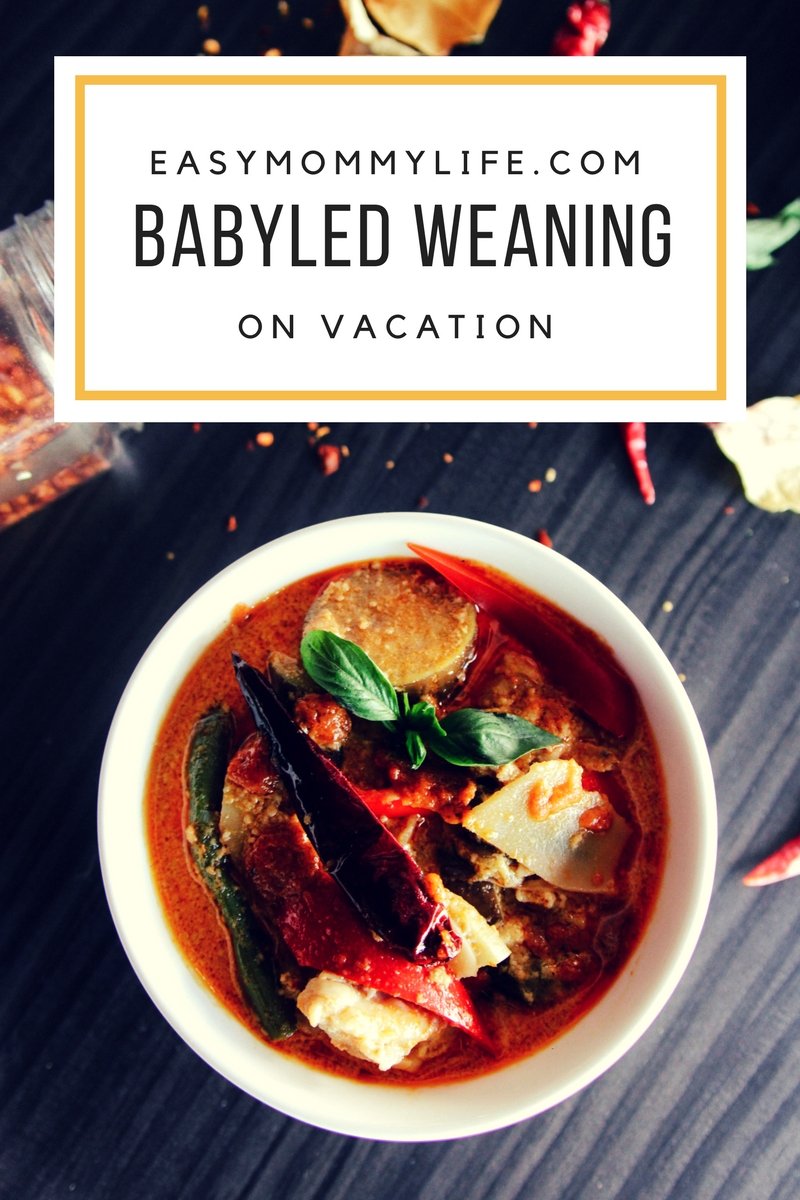
babyled weaning on vacation, bowl of thai soup

Packing tips

  1. A portable booster chair which is lightweight and easy to wipe down.
  2. Carry a LOT of wet wipes. There are going to be messes! You have to be prepared.
  3. Carry a few Ziploc bags. They are handy to dispose of leftovers on the go.
  4. Pack your own baby’s bowls and plates. Preferably with a suction base. This helps when you are eating at restaurants or lovely hotel rooms. You don’t want baby flinging the plate in the air.
  5. Crumb catching bibs are super useful during travel.
  6. Pack foods that can be cooked even with a kettle of hot water like instant oats, homemade baby porridge mix.
  7. Buy reusable pouches, these are great for packing oats/homemade khichdi/thick soups and carrying on a long plane journey or car rides.
  8. If you have a kitchenette available in the hotel room you have more flexibility. You can pack rice, dal, quinoa, pasta, beans etc. Carry all staples you can think of to make quick meals. The hotel room will have sachets of pepper which can be added to give food flavor.
  9. Pack a small frypan and saucepan this helps to make quick meals like scrambled eggs, oats, porridge etc.

Our Experience

We found booking vacation homes through Airbnb more comfortable as it allowed us to be in control of the food we prepare for our baby. We prefer a vacation home as it comes with a kitchen. On our trips, we would feed him in the room and then go out between meals for sightseeing. This vacation routine put him at ease too, since he started expecting his meals at the room and snacks on the go.

When Airbnb has not been possible we have checked with the hotel for kid-friendly meals. Most hotels are happy to oblige. Breakfast we ate at hotel buffets. For all the other meals I planned a menu of what to feed my baby in advance. That way I felt better prepared to handle any changes that happened.

I hope my post on preparing for travel with your baby led weaning baby helped. In the next post, I will cover what can be offered to baby on vacation and a look at what Little A ate on one such vacation we took. See you in the next post!

Sugar And Childhood Obesity

Teaspoon of sugar

A recent study published in the New England Journal of Medicine, highlighted that in 2015 India had the second highest obese children in the world. What has led to this increase in obesity in young children in India? Where have we gone wrong? Are our cultural notions that obese kids are healthy to blame or the growing urbanization and adoption of western diets to blame? Scientists think it’s both.
Sugar has a considerable cultural relevance in India. In the land of festivals, sugary sweets are everywhere. How aware are we as parents about the effects of sugar consumption on our kids?

Let’s dive into this topic and look at some important points to be considered.

What is sugar?

Sugar is a carbohydrate found naturally in most plants, but mainly in sugar cane and sugar beets.

Simple sugars or monosaccharides are glucose, galactose and fructose. Whereas disaccharides are combinations of two sugar molecules. Examples of disaccharides are lactose, maltose and sucrose.

Many of the foods we eat contain naturally occurring amounts of sugars; especially dairy, fruits and some vegetables. When experts talk about reducing sugar content, they don’t mean the naturally occurring ones.  They’re referring to added sugars.

What is added sugar?

The words added sugars and free sugars are used interchangeably, but there are slight differences in their definitions.

  • Added sugars are sugars and syrups put in foods during preparation or processing or added at the table.
  • As per the World Health Organization (WHO) Guidelines: “Free sugars include monosaccharides and disaccharides added to foods and beverages by the manufacturer, cook or consumer and sugars naturally present in honey, syrups, fruit juices and fruit juice concentrates.”

Point to note here is that, the definition for added sugars does not include honey, fruit juices or fruit juice concentrates. The definition for free sugars is therefore more apt, encompassing all known sugars.

Recommendations for sugar

The WHO recommends reducing the intake of these free sugars to less than 10% of total energy intake in both adults and children.

In fact recently in view of the rising obesity levels and related disorders globally, WHO’s expert panel recommended decreasing sugar intake to 5% of total calorie intake to combat obesity. [1]

The American Heart Association (AHA) recommends no more than six teaspoons of added sugar to be consumed by children 2 to 18 years of age. [2]

The AHA also recommends that added sugars should not be included at all in the diet of children under the age of 2 years.

Where are these added sugars?

Well most parents think sugars are only found in sweets and pastries. But that is not the case, with rapidly changing diets and dependence on heavily processed foods, hidden sugars are everywhere.

You can find sugars in everything from baby cereals, purees, granola bars, ketchup, mayonnaise, pasta sauces, cheese spreads, nut bars, peanut butter, yogurts, breads, cured meats and healthier looking versions of toddler snacks labelled from fruit concentrate.

As mothers it becomes important to learn to read labels. Look for the following words on packaging:

  • Sucrose
  • Maltose
  • Lactose
  • Dextrose
  • Fructose
  • Mannitol
  • Sorbitol
  • Xylitol
  • Glucose Syrup
  • Corn Syrup
  • High Fructose Corn Syrup
  • Disaccharides
  • Molasses
  • Invert sugar
  • Honey
  • Jaggery

These are all names for SUGAR!!

How do sugars affect my child?

Sugar intake contributes to accumulation of body fat, hypertriglyceridemia, insulin resistance, metabolic syndrome, diabetes, fatty liver, high level free fatty acids. [3]

It is important to mention here that Indians already have higher NEFAs (Non-Esterified Fatty Acid), insulin resistance, hepatic steatosis and dysglycemia compared to Caucasians. [4]

To add to this, Indians are increasingly consuming traditional Indian sweets along with sugar sweetened beverages, and westernized sugar-loaded food items, which are now easily available due to globalization.

Children are not far behind, the consumption patterns of sweets and beverages are rapidly changing among the children in our country. Sugar sweetened beverages and sugar containing high calorie foods are easily available around school premises.

A study conducted on 1800 school children aged 9-18 years and their mothers from four cities in India: Delhi, Bangalore, Pune and Agra in 2013 showed a high consumption pattern of sweetened food items among children and their mothers.

The study highlighted the role of mothers in deciding the food choices of children and reported a strong association between the dietary intake of children and their mothers for all the studied sweetened food items [5]. The study also showed that any food or food preparation was considered “healthy” if it was “hygienically” prepared. Furthermore, the results showed that the consumption of food among children is influenced by television advertisements, peer pressure and the fashion for consuming westernized foods.
Sugar and our kids picture of icecreams

Think about this

Nutritionally sugar provides only “empty” calories (1 gm of sugar gives 4 calories). It lacks the natural minerals which are present in the beet root or sugarcane.

When we say it’s okay to consume 6 teaspoons or 24 grams of sugar per day, we have to consider the following:

  • 1 tablespoon of ketchup contains 4 grams of sugar
  • 1 small 100gm/3.5 oz container of flavored yogurt contains upto 13 grams of sugar.

These make up just the sides of a single meal. This is where our role as parents really kicks in.

How to avoid too much sugar consumption?

  • Many Indian mothers add sugar even to savory dishes like poha, upma, sabzis and curries. This can be avoided.
  • Enjoy foods with natural sweeteners like jaggery and honey in moderation.
  • Always leave the house prepared. You don’t want a last minute hunger tantrum on your trip where you give in and provide your child with biscuits and sweets. Carry theplas, parathas, boiled sweet potato, vegetable/non-vegetarian patties, wraps, chappatis, fruits or your child’s favourite snacks.
  • Many times mothers prefer packaged foods including bottled beverages at restaurants as they are concerned about hygiene. Again offering coconut water or bottled water instead of sugary drinks can suffice.
  • Always stick to whole foods instead of packaged foods. Labels can be deceiving, not all products may have complete breakdown of added sugars. Look for the “Carbohydrates (of which sugars)” figure in the nutrition label to see how much sugar the product contains for every 100g: Less than 5 gram of sugar per 100 gram of product is considered low in sugar.
  • Offer your child fruit over fruit juice, fruit rollups and fruit pouches.
  • Food pouches for kids are a new trend. But many experts suggest limiting the use after first year of baby’s life. They contain high amounts of sugar, don’t teach the child about the real texture of foods and may lead to tooth decay. These are okay for travel or occasional consumption but definitely not as a replacement for everyday meals.
  • Lastly, it is important to educate our kids on nutrition. What is good food? Why is it important for the body? Also to lead by example, kids learn everything from their parents. It’s best when we model good eating and healthier lifestyle to them.

In conclusion

The intention of this post is not to showcase sugar as the devil that needs to be avoided at all costs instead it is to educate and increase awareness about our knowledge of sugar. Many of us know too much sugar is bad for our health but how many of us are truly aware how much we end up consuming in a day through a seemingly healthy diet.

We owe our children knowledge of good nutrition so we can raise a healthier generation for tomorrow. Stick to home cooked whole foods and leave processed packaged foods for rare occasions. Let’s teach our children how real food looks and tastes like. These minor changes in our perspectives and daily eating habits will impact our children in a great way. My own love for nutrition and good home cooked food was instilled in me by my grandfather. There is no greater gift you can give your child than the gift of good health.

Resources:

1] World Health Organization. WHO Opens Public Consultation on Draft Sugars Guideline. (2014). [online] Available at: http://www.who.int/mediacentre/news/notes/2014/consultation-sugar-guideline/ en/ [Accessed on 06 Jul. 2017].

2] Children should eat less than 25 grams of added sugars daily. (2016). [online] Available at: http://newsroom.heart.org/news/children-should-eat-less-than-25-grams-of-added-sugars-daily [Accessed 6 Jul. 2017].

3] Gulati, S. and Misra, A. (2014). Sugar Intake, Obesity, and Diabetes in India. Nutrients, 6(12), pp. 5955-5974.

4] Misra, A., Ramchandran, A., Jayawardena, R., Shrivastava, U. and Snehalatha, C. (2014). Diabetes in South Asians. Diabet. Med, 31(10), pp. 1153-62.

5] Gulati, S., Misra, A., Colles, S.L., Kondal, D., Gupta, N., Goel, K., Bansal, S., Mishra, M., Madkaikar, V., Bhardwaj, S.(2013). Dietary intakes and familial correlates of overweight/obesity: A four-city study in India. Ann. Nutr. Metab, 62, pp. 279–290.

6] Hubbard, M.D, S. (2013). The Kid’s Doctor: Pass on those fruit and veggies in a pouch. Chicago Tribune. [online] Available at: http://articles.chicagotribune.com/2013-07-03/lifestyle/sns-201307021400–tms–premhnstr–k-n20130703-20130703_1_pureed-baby-food-fruit-and-veggies-apples [Accessed 6 Jul. 2017].

7] The Indian Express (2017). India has second highest obese children in world: Study. [online] Available at: http://indianexpress.com/article/lifestyle/health/india-has-second-highest-obese-children-in-world-study-4702274/ [Accessed 6 Jul. 2017].

Baby Led Weaning Guide For Indian Mothers

Baby led weaning child holding a bowl of food

I stumbled upon baby led weaning when my son was 4 months old. Being a rather unfamiliar method of weaning in India; the literature was sparse in the Indian context. In this post I’ll address some of the concerns Indian moms might have regarding first foods, choking, appropriate gear for baby led weaning, nutrition and much more. Let this post be your baby led weaning guide.

WHY DID I WANT  TO START WEANING THE BABY LED WAY?

As a child, I was a fussy eater and know firsthand how much I hated being cajoled into eating. This became the primary reason why I wanted my son to be in control of how much he wanted to eat.

So,

What is Baby Led Weaning?

Baby led weaning is a method of weaning where the baby is allowed to explore his/her food and self-feed from the age of 6 months. The baby controls how much he/she eats, dines with family and eats what the family eats.

The method seemed perfect in my setup – a nuclear family with a traveling husband. It would cut down on special food preparations and the idea of my kid becoming an independent eater was very appealing.

On a side note – I hold nothing against traditional weaning as long as your child isn’t force-fed and his/her hunger limits are respected. I believe that a basic respect of child’s hunger cues is more important than the ongoing debate on the internet about pros and cons of traditional weaning versus baby led weaning.

Now, let’s address the two elephants in the room:

Choking

Choking is by far the biggest concern for any parent. It is important to note that a baby’s gag reflex is in the front of the mouth which prevents them from choking on food. Babies gag when they are not ready to swallow a big chunk of food.

When a baby chokes their entire airway is blocked, they go silent and may change color in face. Whereas in gagging they cough and look uncomfortable. Make sure never to offer high risk choking foods. Check that every food offered is soft enough to turn to mush between your thumb and forefinger.

A September 2016 study published in the Journal of Pediatrics found that baby-led weaning did not cause more choking than traditional spoon-feeding. (Fangupo et al., 2016).

I have provided an exhaustive list of foods that should be avoided below.

It is very important to understand the difference between choking and gagging. I found this article very helpful in understanding the difference between the two.

Iron rich foods for Baby led weaning

Iron becomes a hot topic of discussion in baby led weaning groups. Breastmilk stores of iron start to drop post 6 months, therefore, it is important to incorporate iron rich foods into your baby’s diet.

Examples of iron rich foods for baby led weaning are Cereals, lentils, legumes, chicken, red meat, egg yolk. Check this post for more detailed ideas about iron rich foods for baby led weaning.

And always remember, if you have concerns about any specific nutrient deficiency you must consult your pediatrician and get blood work done.A list of iron rich foods

What are the first foods for Baby Led Weaning?

As a guideline, cut all foods in long strips so it’s easier for baby to grasp in their tiny palms. Here are a few examples of foods to offer a 6 to 9-month-old:

  • Ripened: Banana, Papaya, Mango, Sapota (Chikoo), Muskmelon, Avocado;
  • Steamed: Apple, Pear, Pumpkin, Cauliflower & Brocolli Florets, Idli;
  • Boiled: Dal, Potato, Sweet Potato, Egg Yolk
  • Cooked: Chicken Liver, Oats, Ragi & Oats Pancake, Scrambled Egg Yolk.

Around 9-10-month-old babies get better at eating due to development of pincer grasp. This is a good time to offer family food in sizes appropriate for pincer grasp.

Always start weaning by introducing one new food at a time and trying it for 3-5 days depending on allergy history of that food in your family.

Choking risk foods

I steered clear from offering any hard raw fruits like apples, pears, grapes etc. for more than a year of baby’s life. Also, I didn’t feel comfortable offering steamed carrots as they always felt to be not soft enough.

It is best to avoid,

  • Whole Nuts
  • Whole Seeds
  • Hard raw fruits (e.g. Apples and Pears)
  • Foods with thick peel (e.g. grapes, plums, tomatoes)
  • Popcorn
  • Chips
  • Lotus Seeds (e.g. Makhane)
  • Raw salad leaves
  • Big chunks of meat
  • Bony Fish

For a more detailed idea of what foods to avoid, I found this link by the New Zealand Ministry of Health very helpful. (Ministry of Health NZ, 2012)
Baby led weaning essentials

Baby Led Weaning Essentials

  • High chair:

    One that is easy to clean. Expect a lot of mess with baby led weaning. So it’s best to have an easy to manage chair.

    • I would recommend the Chicco Pocket Lunch High chair. We used this from the beginning of our BLW journey. It is easy to clean by spraying some water and wiping off. Once a week I pull out the cover and wash under hot water with some soap. The chair comes with a large tray so a lot of the mess stays on the tray itself.
    • Another very popular option is the Ikea Antilop High chair. You can find similar designs to the Ikea Antilop in the Indian market on all the leading retail websites.
  • Booster chairs:

    • I recommend Fisher Price Quick Clean N’ Go Booster. It’s cheap, lightweight, easy to clean, comes with a shoulder strap and has a built-in wipes compartment. This makes this booster the ideal travel companion. Amazon always runs deals on this booster.
    • My second recommendation is Mastela Deluxe Comfort Folding Booster Seat . It’s also easy to clean and lightweight. Additionally, it has a two-level height adjustment which can be used for older toddlers (up to 30 months of age). The only con is that it doesn’t come with a shoulder strap so it’s inconvenient to use for travel.
  • A plastic spray bottle:

  • Feeding plates:

    • Buy plates and bowls with a suction bottom. Babies end up throwing the bowl on the floor and suction bottom is a real effort saver. These bowl and plate sets by Avanchy are very sturdy, made of bamboo wood with silicon headed spoons. The spoon is wonderful for those soft gums and also double up as a teether. To know about our experience using this set head to my post on Avanchy bowl and plate review.
  • Cups:

    • There are varied types of cups available in the market. There will be a lot of trial and error and you have to figure out which one works best for your baby.
    • My recommendations are; 1) Regular stainless steel cup: works from 6 months up, 2) Philips Avent Classic Soft Spout: 6-12 months, 3) Philips Avent Straw cup: 12 months up.
    • For a more detailed review of available Sippy cups in India read this post of mine.

Other Points To Consider

One of the basic tenants of baby led weaning – “The baby eats what the family eats” is not without its caveats because not all families follow healthy diets. The food offered to the baby maybe heavily processed, devoid of nutrition and high in sodium. Parents need to be aware of their children’s nutritional needs and plan healthier family meals.

Most family foods can be modified for your baby by cutting out salt, sugar and reducing spice. An easy alternative is to steam the vegetables separately if you are making a spicy version for yourself.

Also baby requires more fat than adults; if your household follows a low-fat diet then consider adding a side of grated coconut chutney, ghee on chapattis/dal/rice or avocados just for baby.

A 6 to 9-month-old baby is still mastering the pincer grasp making it difficult to properly eat a typical Indian meal. Start out with finger food versions of family meals and slowly ease into a complete family meal as the pincer grasp improves.

Another point that comes up repeatedly is, explaining baby led weaning to the extended Indian family. Here you may have to hold your ground more than a few times. Once non-consenters see the baby eat on their own, they too are proud. Stay patient, its best not to get stressed. Ultimately only the parents are the best judge of what suits them and their baby.

Our Experience With Baby Led Weaning

The idea of a self-feeding baby always appealed to me. There are videos online of 6 to 7-month-old babies eating big chunks of meat off the bone, while its quite an attention getter – I wanted to proceed more gently.

What I loved about our experience with baby led weaning was the freedom from elaborate meal making for me and independence it offered my child from the onset. We introduced him to a wide variety of fresh fruits and vegetables in the first year. And it is amazing watching just how quickly our little humans pick up all the skills. Baby led weaning and “no pressure tactics at the table” allowed him to be a great eater and a happier child.

To sum it up

  • Feeding your child should focus on sharing in the joy of eating healthy and nutrient-rich foods. Don’t worry too much about the rules!
  • If your baby is having a difficult time with baby led weaning you can always try pre-loaded spoons or switch to traditional weaning.

Whatever ways you choose to wean you need to be respectful of your baby’s hunger. If they squirm and move their head side to side, spitting out what you feed, stop the session. Try again later. An unhappy baby at the table will never learn to associate food time with positive interactions. You have to be patient and let your child lead.

Related Posts On Baby Led Weaning

Baby led weaning first foods: What to offer?

7 Baby Led Weaning Benefits No One Tells You About

Baby Led Weaning Finger Foods On The Go

5 Baby Led Weaning Tips For Success

6 Healthy Baby Led Weaning Lunch Ideas

Baby Led Weaning Food Ideas For Busy Moms

Baby-led Weaning On Vacation (Part 1)

Baby-led Weaning On Vacation (Part 2)

Baby Led Weaning Breakfast Ideas

Resources:

1] Fangupo, L., Heath, A., Williams, S., Erickson Williams, L., Morison, B., Fleming, E., Taylor, B., Wheeler, B. and Taylor, R. (2016). A Baby-Led Approach to Eating Solids and Risk of Choking. Pediatrics, 138(4), pp.e20160772-e20160772.

2] Baby Led Weaning: A Complete Guide to Choking & Gagging. (2014). [Blog] Baby Led Weaning Equipment. [Accessed 10 May 2017].

3] Ministry of Health NZ. (2012). Foods that pose a higher choking risk for children under five years. [Accessed 10 May 2017].[/box]

Disclaimer: This is a parenting blog. The opinions expressed here represent my own and do not replace professional medical advice. Consult your pediatrician and nutritionist for any concerns you may have.
This blog post contains affiliate links. These links provide me with a small percentage commission but don’t cost you anything extra.

Top 10 Tips For Breastfeeding Success

Mother breastfeeding her baby

When I found out I am pregnant, I rushed out to buy my own copy of “What to expect when you are expecting?” After reading the entire book I was still left with many questions & doubts regarding pregnancy, labor and motherhood. The only topic I took for granted was breastfeeding.

“Isn’t breastfeeding natural, why should I worry about it?” I thought my body would just figure it out. It is quite common for pregnant women to take breastfeeding lightly. We assume it is what all women do without any trouble. This is because we as women don’t talk about breastfeeding with other new moms. We push this very important topic to the side and let shopping for baby and building a nursery, preparations for labor etc. take precedence in our conversations with new mothers.

I started out with a goal to breastfeed my baby for 6 months, but here I am at 14 months and still going strong. A lot has changed since day 1 of Little A’s life, there is a lot I wish I knew when I started my breastfeeding journey. But that is the intention of this blog post. As new moms, we all want to know what exactly we can do to have that successful breastfeeding journey. And hopefully, my top tips will help on your breastfeeding journey with your baby.

breastfeeding tips-increase breastmilk supply

Build your success team

You need your husband, mother, and mother-in-law whoever is in it with you in terms of the baby care to be on board the breastfeeding train. Breast milk takes time to establish so keep feeding the baby as many times as he/she demands. Then there are growth spurts too with dips in milk supply. During these crucial times you want your support system to be on board and not pressure you to give in and give the formula bottle. Sit everyone down and make your breastfeeding goals clear. Ask them to help out with home chores, baby care and cooking so that you can focus on feeding baby with no other stressors.

Proper latch

Make sure to have a proper latch established. If it hurt’s every time you feed most probably the latch isn’t correct. Most hospitals have a nurse come in and help latch the baby on the first time. My hospital also sent in a lactation consultant and she guided me through different positions, how a good latch looks etc.

A good latch is when you start with baby’s nose to your nipple so that they can open their mouth wide and your nipple can touch the roof of the baby’s mouth. The lower part of breast and areola should be covered by baby’s mouth this ensures proper sucking action. I have linked below a series of videos that cover the topic of proper latch and positions for breastfeeding. These are great resources for new moms like you.

Lactation Expert

As I mentioned in the point above if there are any nagging doubts in your mind or pain during feeds or just to ensure you are doing it all correctly, get in touch with a Lactation Consultant. Not only will they guide you on getting the latch right but also demonstrate different positions to hold the baby in while feeding, how to burp the baby etc. I found my session with the LC in the hospital very informative and comforting that I am on the right track.

Another way to learn all about breastfeeding is through an online self-paced breastfeeding class. Sometimes we have limited time with our LC’s or find that breastfeeding brings with it unannounced challenges at odd hours of the day. Investing in an online lactation class helps you with all the correct information you need at your fingertips.

Rest and relax [create a nursing corner]

The initial weeks go by in such a daze. You are still exhausted from the labor and now you are feeding your baby round the clock every 2-3 hours. Just use these initial weeks to relax and bond with your baby. Don’t stress too much about cleaning up the house, or baby care. Buy all baby items before the delivery or if you are still lacking key essentials get your husband to run errands.

Create a small Nursing Corner next to your bed or baby’s crib where you can sit comfortably, add a lot of pillows, a water bottle, nipple cream, snacks (e.g. dry fruits and dates), a table clock and a notebook (or app) to track the feed duration and time, a good book to read. I started enjoying my nursing sessions once this little area was created for me. I didn’t have to worry about anything as everything was already by my side.

Stay hydrated

Breastmilk is more than 80% water and nursing frequently makes one thirsty. Drink lots of water. Incorporate soups, smoothies, juices in your diet, the more nutrient packed the better. These are a great addition to a nursing mother’s diet.

Eat nourishing foods

Eating nourishing and healthy foods helps you recuperate faster and build your depleted resources once again. Have your mom, family and friends send you fresh home cooked meals those initial weeks. In time when you gain your strength back, invest a few hours on weekends and make weekly preparations or batch cook meals for your family. Look for one pot meal ideas. Learn to snack healthy. There are many healthy snack ideas you can choose from.

Also, I know a lot of us slack on taking our vitamins but as long as you are nursing take all your supplements daily. Focus on your health and body as you need to not only nourish your body but your baby too.

Nipple butter

In case you develop cracked nipples, it is best to apply natural nipple butter between feeds and wipe with a warm washcloth before feeding. I would highly recommend Earth Mama Angel Baby Nipple Butter or Motherlove Nipple Cream.

Breastfeeding Pillow

The first problem I encountered as a new nursing mom was exhaustion and arm pain with all the nursing round the clock. Then on a friend’s recommendation, my husband went to a local store and bought me a nursing pillow. I was skeptical at first and thought “How can this help me, I am doing the same thing here with regular pillows”. But it did!  My breastfeeding pillow was my best friend for the first three months of baby’s life. I used it at every feed. It gave good arm and back support. It is so much more comfortable to feed using the breastfeeding pillow. I would highly recommend getting a nursing pillow or boppy pillow, whichever you like. You need it, trust me if you want to breastfeed comfortably get one.

Don’t start pumping immediately

I avoided pumping until 6 weeks because I didn’t want Little A to have nipple confusion. Also in the initial days milk comes in mere drops, which could end up scaring you about quantity. Remember infants have tiny stomachs and as long as your baby is sleeping well after feeds and producing at least 6 wet diapers a day along with steady weight gain, don’t stress about quantity of milk. It’s best you first establish your breastfeeding relationship with your baby and get comfortable with breastfeeding before introducing the pump. That said once you have an established milk supply it’s a wonderful break for tired moms to keep some milk aside for baby and let another family member feed the baby.

It gets better

No matter what difficulty you are going through right now with breastfeeding it will get better. Keep persisting. You will develop your own relationship with your child and soon both will be pro’s at it. Even if you manage to breastfeed your infant for just one day and for whatever reason you were not successful still pat yourself on the back. There is no need for guilt.

Further reading:  Breastfeeding Essentials For New Moms

Great videos that helped me:

Good latch

Attaching baby to breast

Positions for breastfeeding

How to express breast milk

You can also find support online on Facebook through a group called “Breastfeeding Support For Indian Mothers”.

“Mothers and babies form an inseparable biological and social unit; the health and nutrition of one group cannot be divorced from the health and nutrition of the other.” – World Health Organization

This blog post contains affiliate links. These links provide me with a small percentage commission but don’t cost you anything extra.