How To Encourage Healthy Eating Habits In Your Fussy Eater

picky eater-fussy eater-strategies-tips

If there is one common problem most mother’s face, it is fussy eating. This kind of eating behaviour is discussed constantly on mommy forums and groups. We all want our children to eat healthy and have good eating habits. What can be done to encourage healthy eating habits in our children?

Let’s get to the bottom of this. We need to start by understanding eating behaviours. Why is it that an infant who loved a varied diet suddenly turned into a fussy eater?

Most researchers pin this down to a protectionist behaviour in toddlers. Around one year of age they finally begin to understand what they eat and can exert a level of control on how much they can eat. This brings with it a certain level of self protection and guard against different flavours and textures. They crave sameness and consistency. This mechanism helps them feel safe and protected in a period where they are rapidly developing new skills such as speech, walking, running, climbing, certain new cognitive skills etc.

Picky eating is also looked at as a protective natural instinct from an evolutionary standpoint. Toddlers being explorers used to roam free and were exposed to different plants and herbs some of which could be poisionous. This protective instinct helped them from accidently eating a poisonous plant.

Another important aspect to consider as per the American Academy of Pediatrics is that physical growth slows down in the toddler years as compared to the first year of life. This means reduced consumption of food which the care giver can mistake as fussy eating.

Understanding portion sizes is therefore key as toddlers do not need as much food as adults as their stomachs are only the size of their clenched fist. (Dosman & Andrews, 2012). This article shows an exact depiction of what toddler portion sizes looks like.

Picky eating therefore is common due to biological and developmental reasons, as children from ages one to three are exerting their control. This is an important fact to note so that you don’t blame yourself as a parent or blame your child as being naughty, controlling, tantrum throwing  and disinterested in food. When you know its a part of development you can begin to take necessary steps anticipating this behaviour.

Setting food preferences and positive parental modelling

You may wonder why I am focussing so much on the infant and toddler years. This is because experiences with food and food preferences are formed in infancy and early childhood.

Did you know breastfeeding is known to expose infant to a variety of flavours from maternal diet?  Infants have a preference for sweet and salty taste, but through the mother’s milk they may be exposed to newer and different flavours. This helps promote acceptance of these flavours when introduced later through solid foods.

Children’s preferences are also influenced based on availability, continuous exposure and thus familiarity to foods. Positive parental modelling is also shown to lead children to select healthier foods for life. If you don’t make the correct changes at this stage then it becomes harder to change certain preset eating habits later.
Tips picky eating-tackle fussy eating

Strategies to change your fussy eater into a healthy eater

    1. Breastfeeding has shown to help in development of a child’s response to internal hunger and satiety cues, and the development of self-regulatory abilities during feeding. This should be carried forward in the weaning stages as well. Baby led weaning is a great way to follow on the path of a more child led way of weaning. But if you are going the traditional weaning route, no problem, respond to your child’s hunger cues at the table. If they are disinterested in a feeding session, stop the session. No point in making it a control game at the table. It is also suggested to introduce lumpy foods early on (before 9 months of age). This will help baby get used to textures from the onset.
    2. A responsive “do as I do” approach has a positive effect on children’s consumption patterns than the unresponsive “do as I say” approach to parenting. Parental modeling of healthy eating behaviours is the first step in solving the fussy eaters drama. Do you eat as a family at the table? Does your child see you eat vegetables and enjoy them too? What do you snack on in front of your child, biscuits? Ice cream? Are you eating a lot of take-out and serving your child special healthy meals while he watches you eat take-out? A lot will be revealed about the family eating patterns in the answers to these questions. Again you don’t want to be banning these food items either (that may backfire later in life too!), but please know what moderation looks like. Children want to be like their parents, if you are happy eating broccoli then they will be too! Make family style dining a tradition at the dinner table. Talk about food you are eating and where it came from at dinner.
    3. Prepare a different variety of the same vegetable. Keeps things interesting and the kids love trying new flavours. One day add broccoli in a pasta dish, the next in a salad then another day steamed as a side.
    4. Create abundance of whole unprocessed foods in the house. When there is abundance picking the healthy option is easy. Stock your house with fruits and vegetables instead of fruit juices, fruit roll ups and other such packaged foods. Teach your child how to eat food in the form nature presented it.
    5. Praise them when they try new foods or eat independently. Positive feedback encourages them to try it again.
    6. Are you are doing everything right, yet your child won’t eat? Consistency helps in this case. Keep offering foods they don’t touch on the plate as a part of their meals. Research shows it takes upto 10 exposures before they choose to eat it. Most parent’s give up before that. I get it, we don’t like seeing food go to waste, but think of it as an effort to set a lifetime of eating habits. My son is not a fan of dal, regardless I always offer it on his plate. He went months without touching it and then all of a sudden he was drinking it like soup! At present he eats it some days and won’t touch it some other days. But dal is always served to him on his plate.
    7. Don’t stress. I read a line somewhere that stayed with me. “Unless they are ill, a young child will never voluntarily starve themselves.” As parents we worry so much about the quantity of food our kids eat instead of focussing on their overall acitivty levels. Are they energetic? Children tend to graze on food constantly, it may look like they aren’t eating anything but those tiny meals throughout the day add up. Keep an eye on their growth charts and as long as they are growing as per the charts relax and let them be.

tips-picky eating-fussy eating 

  1. Another often used tactic is to cajole children to eat their food and reward with a sweet treat if they do. This does more harm than good. What you teach your child instead is to look at sweet food as special food. This ends up creating a soft spot towards sweet foods as comfort foods that helped them cope with high stress scenarios. It is also teaching them to finish everything on the plate without listening to their inner hunger cues. This sets a pattern towards unhealthy eating habits for life. Instead focus on creating a positive environment around food and not cajoling and rewarding with sweet treats.
  2. Messy play is a great way to get your child to be comfortable with textures. It is very important to get messy at the table and during play. Embrace the mess!
  3. Get your children excited about food. Cook together, go to the market and read books around different foods. All this helps at the table too. It encourages them to eat their food as they feel a part of the process of making it.
  4. Offer variety from an early age. Offer color on the plate. Make food look appealing, its not just cutting food in cute shapes, sometimes the different foods and colors also look appealing on a plate. You don’t have to cook something elaborate every time. Here are some quick and easy baby led weaning ideas for days you are busy and don’t have time to cook a meal from scratch.
  5. If they don’t like one type of food, make alternatives around it. Example: doesn’t like dal, make dal soup, lentil fritters, quinoa and lentils cakes; while consistently serving dal too.
  6. I mentioned this earlier, be aware about portion sizes for toddlers. Many traditional weaning practices are still modeled around food scarcity and under nutrition model of yesteryears. These were problems in the past, the scenario has changed today to a more food abundant stage. So the traditional practices of serving large portion sizes of energy dense foods can lead to problems like obesity and other diseases. Assess food intake over a week rather than daily along with overall energy levels of the child.
  7. Our role as adults should focus on education, teaching children to listen to their own bodies, facilitating an interaction with healthy food and fun learning experiences around food. The adult decides what to serve the child and, based on what is served, the child will decide what and how much to eat (Horodynski & Stommel, 2005).

To summarize for you, consistently serve healthy foods to your children alongside building a positive environment for them to learn about their foods.

What strategies worked for you with your fussy eater? Let me know in the comments below.

References:

Scaglioni, S., Arrizza, C., Vecchi, F. and Tedeschi, S. (2011). Determinants of children’s eating behavior. The American Journal Of Clinical Nutrition, 94, pp.Suppl 2006S-2011S.

Brown, R. and Ogden, J. (2004). Children’s eating behaviour and attitudes: a study of the modelling and control theories of parental influence. Health Education Research, 19(3), pp.261-271.

Birch, D., Savage, J. and Ventura, A. (2007). Influences on the Development of Children’s Eating Behaviours: From Infancy to Adolescence. Can J Diet Pract Res, 68(1), pp.s1-s56.

Horodynski, M. and Stommel, M. (2005). Nutrition education aimed at toddlers: An interventiontion study. Pediatric Nursing, 31. Pediatric Nursing, 31.

Dosman, C.and Andrews, D. (2012). Anticipatory guidance for cognitive and social-emotional development: birth to five years. Pediatrics and Child Health, 17, 75-80.

Baby led Weaning On Vacation (Part 1)

babyled weaning on vacation

There is a lot to consider when planning a trip with a baby. New parents worry about providing nutritious meals on vacation and rightfully so. With a baby led-weaned child it’s easier to provide from varied food options, albeit the mess! In this post, I shed light on how to prepare for the trip.

If you are new here, check my first post introducing moms to the concept of babyled weaning, before you start.

Now back to babyled weaning on vacation.

Points to consider

  • What type of vacation are you planning? Local/Abroad
  • Length of the Vacation
  • Age of your child. Is the vacation going to be in the initial stages of babyled weaning or once the baby is more advanced with their eating skills?
  • Equipment to carry
  • Type of accommodation; will it be an accommodation with attached kitchen (where you can prepare meals) or a hotel room.
  • Will there be periods of intense travel with minimal access to fresh food like airplane journeys, long bus/train rides, long car drives.

How to prepare?

If your baby is 6 – 8 months old you may be still primarily breastfeeding or bottle feeding. At this stage, you have to plan about 2-3 meals a day. These can be simple finger foods, fruits & food pouches.

If your baby is older than 8 months plan extra meals or snacks along with the regular 2 – 3 meals.

Any vacation is bound to affect the baby’s routine. It’s best to be mentally prepared for any curveball that’s thrown your way. Always carry snacks like rice cakes, fruits, natural yogurt pots, cheese for any eventuality. Many baby led weaning moms also prefer to carry a few food pouches for baby on the go. It’s always good to have them as backups.

I will get into details of what can be fed to your baby in the next post; in this post let’s look at some preparations you will have to do prior to your trip.
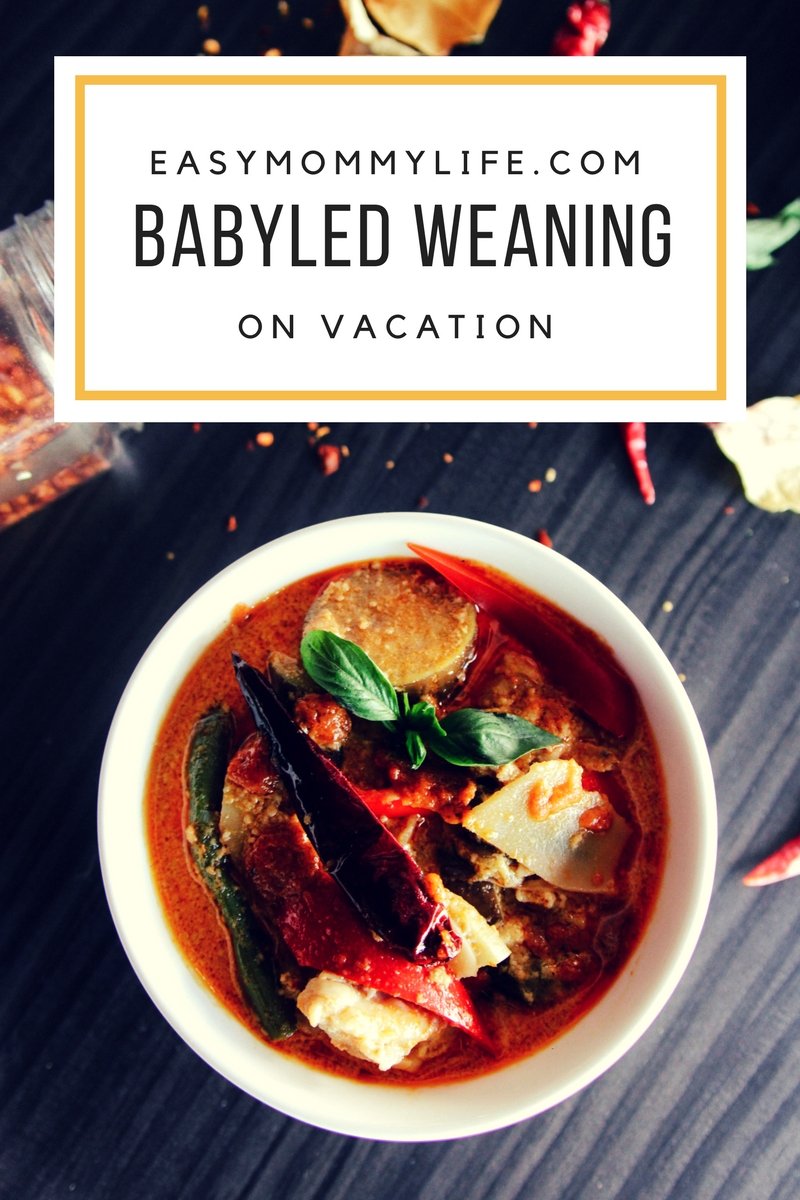
babyled weaning on vacation, bowl of thai soup

Packing tips

  1. A portable booster chair which is lightweight and easy to wipe down.
  2. Carry a LOT of wet wipes. There are going to be messes! You have to be prepared.
  3. Carry a few Ziploc bags. They are handy to dispose of leftovers on the go.
  4. Pack your own baby’s bowls and plates. Preferably with a suction base. This helps when you are eating at restaurants or lovely hotel rooms. You don’t want baby flinging the plate in the air.
  5. Crumb catching bibs are super useful during travel.
  6. Pack foods that can be cooked even with a kettle of hot water like instant oats, homemade baby porridge mix.
  7. Buy reusable pouches, these are great for packing oats/homemade khichdi/thick soups and carrying on a long plane journey or car rides.
  8. If you have a kitchenette available in the hotel room you have more flexibility. You can pack rice, dal, quinoa, pasta, beans etc. Carry all staples you can think of to make quick meals. The hotel room will have sachets of pepper which can be added to give food flavor.
  9. Pack a small frypan and saucepan this helps to make quick meals like scrambled eggs, oats, porridge etc.

Our Experience

We found booking vacation homes through Airbnb more comfortable as it allowed us to be in control of the food we prepare for our baby. We prefer a vacation home as it comes with a kitchen. On our trips, we would feed him in the room and then go out between meals for sightseeing. This vacation routine put him at ease too, since he started expecting his meals at the room and snacks on the go.

When Airbnb has not been possible we have checked with the hotel for kid-friendly meals. Most hotels are happy to oblige. Breakfast we ate at hotel buffets. For all the other meals I planned a menu of what to feed my baby in advance. That way I felt better prepared to handle any changes that happened.

I hope my post on preparing for travel with your baby led weaning baby helped. In the next post, I will cover what can be offered to baby on vacation and a look at what Little A ate on one such vacation we took. See you in the next post!

Baby Led Weaning Guide For Indian Mothers

Baby led weaning child holding a bowl of food

I stumbled upon baby led weaning when my son was 4 months old. Being a rather unfamiliar method of weaning in India; the literature was sparse in the Indian context. In this post I’ll address some of the concerns Indian moms might have regarding first foods, choking, appropriate gear for baby led weaning, nutrition and much more. Let this post be your baby led weaning guide.

WHY DID I WANT  TO START WEANING THE BABY LED WAY?

As a child, I was a fussy eater and know firsthand how much I hated being cajoled into eating. This became the primary reason why I wanted my son to be in control of how much he wanted to eat.

So,

What is Baby Led Weaning?

Baby led weaning is a method of weaning where the baby is allowed to explore his/her food and self-feed from the age of 6 months. The baby controls how much he/she eats, dines with family and eats what the family eats.

The method seemed perfect in my setup – a nuclear family with a traveling husband. It would cut down on special food preparations and the idea of my kid becoming an independent eater was very appealing.

On a side note – I hold nothing against traditional weaning as long as your child isn’t force-fed and his/her hunger limits are respected. I believe that a basic respect of child’s hunger cues is more important than the ongoing debate on the internet about pros and cons of traditional weaning versus baby led weaning.

Now, let’s address the two elephants in the room:

Choking

Choking is by far the biggest concern for any parent. It is important to note that a baby’s gag reflex is in the front of the mouth which prevents them from choking on food. Babies gag when they are not ready to swallow a big chunk of food.

When a baby chokes their entire airway is blocked, they go silent and may change color in face. Whereas in gagging they cough and look uncomfortable. Make sure never to offer high risk choking foods. Check that every food offered is soft enough to turn to mush between your thumb and forefinger.

A September 2016 study published in the Journal of Pediatrics found that baby-led weaning did not cause more choking than traditional spoon-feeding. (Fangupo et al., 2016).

I have provided an exhaustive list of foods that should be avoided below.

It is very important to understand the difference between choking and gagging. I found this article very helpful in understanding the difference between the two.

Iron rich foods for Baby led weaning

Iron becomes a hot topic of discussion in baby led weaning groups. Breastmilk stores of iron start to drop post 6 months, therefore, it is important to incorporate iron rich foods into your baby’s diet.

Examples of iron rich foods for baby led weaning are Cereals, lentils, legumes, chicken, red meat, egg yolk. Check this post for more detailed ideas about iron rich foods for baby led weaning.

And always remember, if you have concerns about any specific nutrient deficiency you must consult your pediatrician and get blood work done.A list of iron rich foods

What are the first foods for Baby Led Weaning?

As a guideline, cut all foods in long strips so it’s easier for baby to grasp in their tiny palms. Here are a few examples of foods to offer a 6 to 9-month-old:

  • Ripened: Banana, Papaya, Mango, Sapota (Chikoo), Muskmelon, Avocado;
  • Steamed: Apple, Pear, Pumpkin, Cauliflower & Brocolli Florets, Idli;
  • Boiled: Dal, Potato, Sweet Potato, Egg Yolk
  • Cooked: Chicken Liver, Oats, Ragi & Oats Pancake, Scrambled Egg Yolk.

Around 9-10-month-old babies get better at eating due to development of pincer grasp. This is a good time to offer family food in sizes appropriate for pincer grasp.

Always start weaning by introducing one new food at a time and trying it for 3-5 days depending on allergy history of that food in your family.

Choking risk foods

I steered clear from offering any hard raw fruits like apples, pears, grapes etc. for more than a year of baby’s life. Also, I didn’t feel comfortable offering steamed carrots as they always felt to be not soft enough.

It is best to avoid,

  • Whole Nuts
  • Whole Seeds
  • Hard raw fruits (e.g. Apples and Pears)
  • Foods with thick peel (e.g. grapes, plums, tomatoes)
  • Popcorn
  • Chips
  • Lotus Seeds (e.g. Makhane)
  • Raw salad leaves
  • Big chunks of meat
  • Bony Fish

For a more detailed idea of what foods to avoid, I found this link by the New Zealand Ministry of Health very helpful. (Ministry of Health NZ, 2012)
Baby led weaning essentials

Baby Led Weaning Essentials

  • High chair:

    One that is easy to clean. Expect a lot of mess with baby led weaning. So it’s best to have an easy to manage chair.

    • I would recommend the Chicco Pocket Lunch High chair. We used this from the beginning of our BLW journey. It is easy to clean by spraying some water and wiping off. Once a week I pull out the cover and wash under hot water with some soap. The chair comes with a large tray so a lot of the mess stays on the tray itself.
    • Another very popular option is the Ikea Antilop High chair. You can find similar designs to the Ikea Antilop in the Indian market on all the leading retail websites.
  • Booster chairs:

    • I recommend Fisher Price Quick Clean N’ Go Booster. It’s cheap, lightweight, easy to clean, comes with a shoulder strap and has a built-in wipes compartment. This makes this booster the ideal travel companion. Amazon always runs deals on this booster.
    • My second recommendation is Mastela Deluxe Comfort Folding Booster Seat . It’s also easy to clean and lightweight. Additionally, it has a two-level height adjustment which can be used for older toddlers (up to 30 months of age). The only con is that it doesn’t come with a shoulder strap so it’s inconvenient to use for travel.
  • A plastic spray bottle:

  • Feeding plates:

    • Buy plates and bowls with a suction bottom. Babies end up throwing the bowl on the floor and suction bottom is a real effort saver. These bowl and plate sets by Avanchy are very sturdy, made of bamboo wood with silicon headed spoons. The spoon is wonderful for those soft gums and also double up as a teether. To know about our experience using this set head to my post on Avanchy bowl and plate review.
  • Cups:

    • There are varied types of cups available in the market. There will be a lot of trial and error and you have to figure out which one works best for your baby.
    • My recommendations are; 1) Regular stainless steel cup: works from 6 months up, 2) Philips Avent Classic Soft Spout: 6-12 months, 3) Philips Avent Straw cup: 12 months up.
    • For a more detailed review of available Sippy cups in India read this post of mine.

Other Points To Consider

One of the basic tenants of baby led weaning – “The baby eats what the family eats” is not without its caveats because not all families follow healthy diets. The food offered to the baby maybe heavily processed, devoid of nutrition and high in sodium. Parents need to be aware of their children’s nutritional needs and plan healthier family meals.

Most family foods can be modified for your baby by cutting out salt, sugar and reducing spice. An easy alternative is to steam the vegetables separately if you are making a spicy version for yourself.

Also baby requires more fat than adults; if your household follows a low-fat diet then consider adding a side of grated coconut chutney, ghee on chapattis/dal/rice or avocados just for baby.

A 6 to 9-month-old baby is still mastering the pincer grasp making it difficult to properly eat a typical Indian meal. Start out with finger food versions of family meals and slowly ease into a complete family meal as the pincer grasp improves.

Another point that comes up repeatedly is, explaining baby led weaning to the extended Indian family. Here you may have to hold your ground more than a few times. Once non-consenters see the baby eat on their own, they too are proud. Stay patient, its best not to get stressed. Ultimately only the parents are the best judge of what suits them and their baby.

Our Experience With Baby Led Weaning

The idea of a self-feeding baby always appealed to me. There are videos online of 6 to 7-month-old babies eating big chunks of meat off the bone, while its quite an attention getter – I wanted to proceed more gently.

What I loved about our experience with baby led weaning was the freedom from elaborate meal making for me and independence it offered my child from the onset. We introduced him to a wide variety of fresh fruits and vegetables in the first year. And it is amazing watching just how quickly our little humans pick up all the skills. Baby led weaning and “no pressure tactics at the table” allowed him to be a great eater and a happier child.

To sum it up

  • Feeding your child should focus on sharing in the joy of eating healthy and nutrient-rich foods. Don’t worry too much about the rules!
  • If your baby is having a difficult time with baby led weaning you can always try pre-loaded spoons or switch to traditional weaning.

Whatever ways you choose to wean you need to be respectful of your baby’s hunger. If they squirm and move their head side to side, spitting out what you feed, stop the session. Try again later. An unhappy baby at the table will never learn to associate food time with positive interactions. You have to be patient and let your child lead.

Related Posts On Baby Led Weaning

Baby led weaning first foods: What to offer?

7 Baby Led Weaning Benefits No One Tells You About

Baby Led Weaning Finger Foods On The Go

5 Baby Led Weaning Tips For Success

6 Healthy Baby Led Weaning Lunch Ideas

Baby Led Weaning Food Ideas For Busy Moms

Baby-led Weaning On Vacation (Part 1)

Baby-led Weaning On Vacation (Part 2)

Baby Led Weaning Breakfast Ideas

Resources:

1] Fangupo, L., Heath, A., Williams, S., Erickson Williams, L., Morison, B., Fleming, E., Taylor, B., Wheeler, B. and Taylor, R. (2016). A Baby-Led Approach to Eating Solids and Risk of Choking. Pediatrics, 138(4), pp.e20160772-e20160772.

2] Baby Led Weaning: A Complete Guide to Choking & Gagging. (2014). [Blog] Baby Led Weaning Equipment. [Accessed 10 May 2017].

3] Ministry of Health NZ. (2012). Foods that pose a higher choking risk for children under five years. [Accessed 10 May 2017].[/box]

Disclaimer: This is a parenting blog. The opinions expressed here represent my own and do not replace professional medical advice. Consult your pediatrician and nutritionist for any concerns you may have.
This blog post contains affiliate links. These links provide me with a small percentage commission but don’t cost you anything extra.